
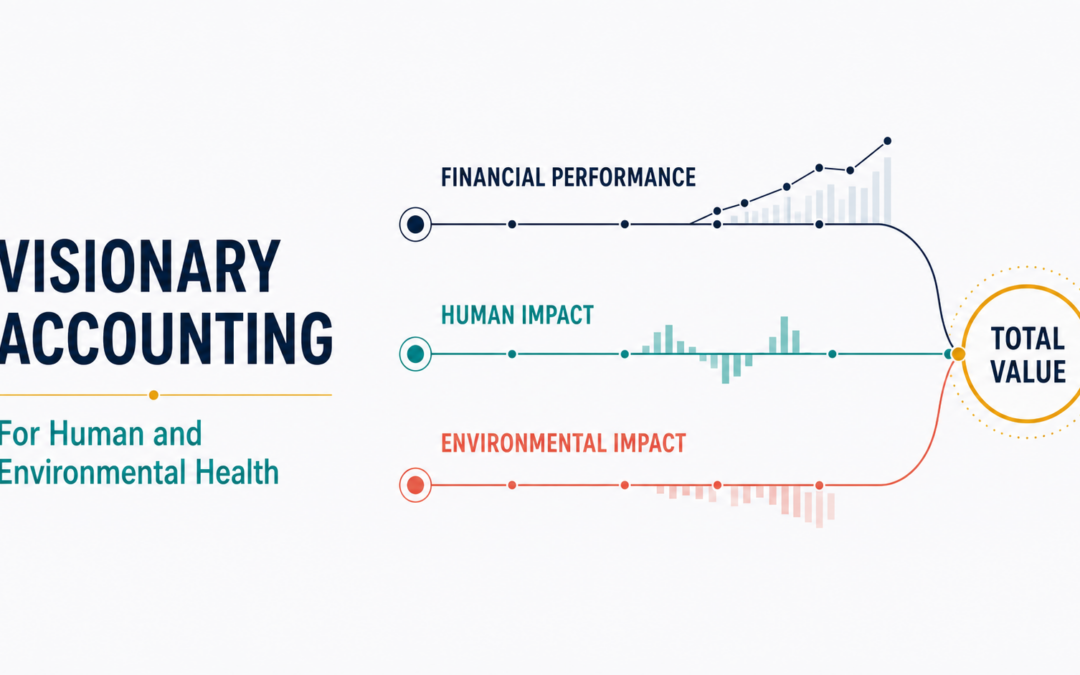
Visionary Accounting for Human and Environmental Health
What if accounting did more than measure financial performance? What if it helped us design healthier companies, healthier people and a healthier planet?
Every business is built on a formula.
Capital, labor, materials, energy, assumptions and choices go into the formula. Products, services, profits—and consequences—come out.
Traditional accounting tells us whether that formula made money. But what if it also made people sick, depleted soil, consumed water faster than it could be replenished, weakened communities or transferred costs to governments and future generations?
The financial accounts may show a profit. The wider world may be carrying a loss.
That gap is the territory of visionary accounting.
The Boundary Problem
A conventional profit-and-loss statement records the costs incurred by a company. It does not necessarily record all the costs caused by that company.
When a cost falls outside the boundary of the financial ledger, it does not disappear. Someone—or something—still carries it.
It may be carried by:
-
A person living with chronic disease
-
A family struggling with the cost of care
-
A government funding preventable health consequences
-
A community exposed to pollution
-
An employee experiencing exhaustion or insecurity
-
An ecosystem losing water, soil, biodiversity or resilience
-
A future generation inheriting depleted natural and social capital
The financial statement may be accurate within its defined boundary while remaining profoundly incomplete.
This leads to one of the central insights of visionary accounting:
Profit is not, by itself, proof that value has been created. It may simply mean that some of the costs have not been counted.
Every P&L depends on what sits inside its boundary.
From Bean Counting to Intentional Design
Traditional accounting asks:
What happened?
Strategic finance asks:
What choices will create durable value?
Visionary accounting asks:
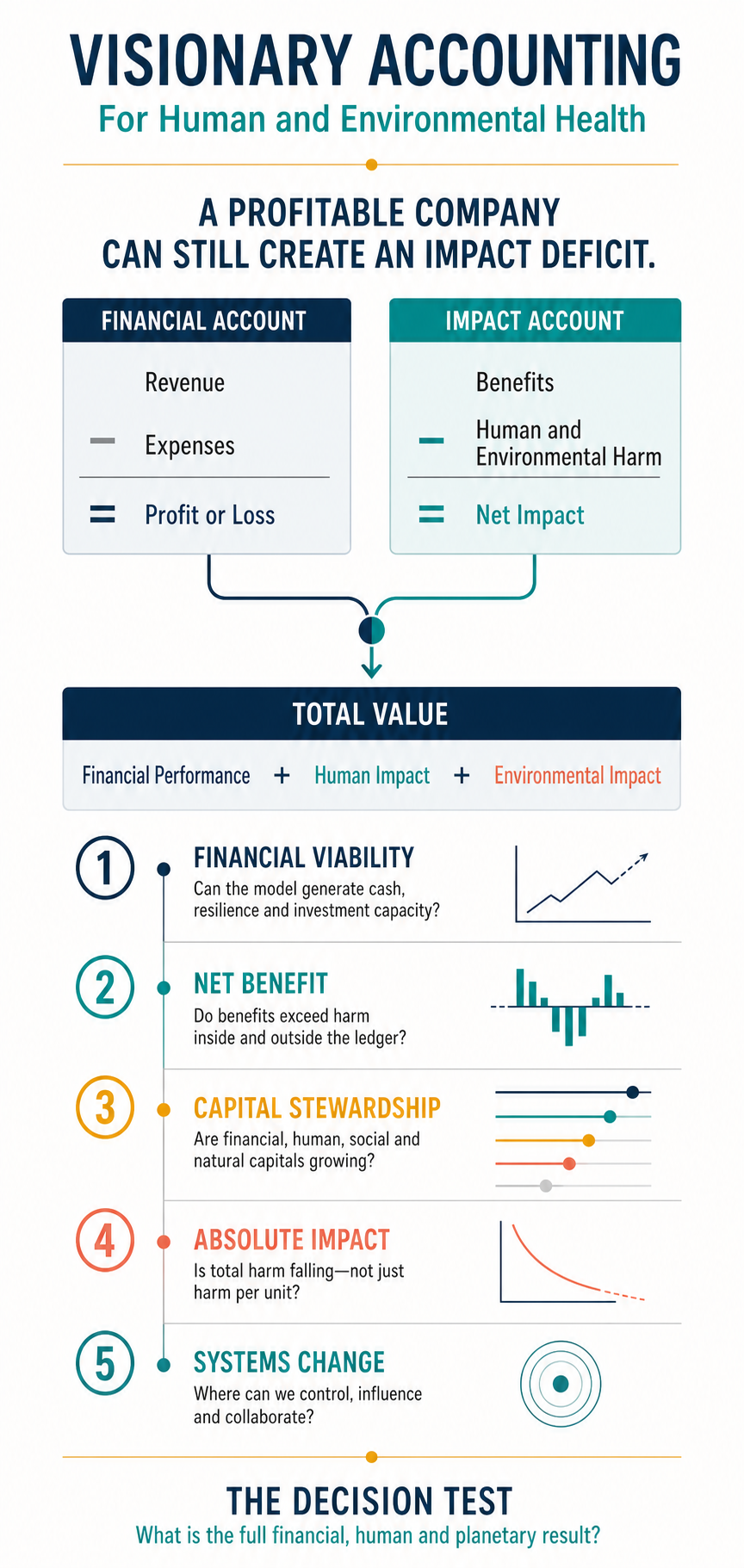
What is the full financial, human, social and environmental result of those choices?
Visionary accounting does not reject conventional accounting. Financial viability remains essential. An organization that cannot generate cash, manage risk or invest in its future cannot sustain its purpose.
But viability is the foundation of success—not its complete definition.
Finance should not merely explain results after they occur. It should help shape the assumptions, incentives, investments and operating decisions that produce those results.
In other words, finance should become a design function.
The Five Questions of Visionary Accounting
1. Are we financially viable?
The first responsibility of finance remains financial health.
Does the organization understand its revenues, costs, margins, cash requirements, risks and capital needs? Can it remain resilient through changing economic conditions? Is it allocating resources toward its most important long-term priorities?
But the deeper question is whether finance is influencing strategy before the result—not merely reporting it afterward.
2. Do we create more benefit than harm?
A profitable company can still produce a negative total impact.
Visionary accounting therefore asks what the organization creates beyond revenue:
-
Does the product support or undermine human health?
-
Does the business strengthen or weaken livelihoods?
-
Does it restore or deplete natural systems?
-
Does it build trust or erode it?
-
Does it solve problems or transfer them elsewhere?
The objective is not to assign a monetary value to everything simply to create the appearance of precision. It is to make material consequences visible before decisions are made.
Financial profit plus negative total impact is an incomplete—and ultimately vulnerable—business model.
3. Are our capitals growing or shrinking?
Financial capital is only one form of productive wealth.
Every company also depends on human capability, knowledge, relationships, trust and functioning natural systems. The Integrated Reporting Framework describes six interconnected capitals: financial, manufactured, intellectual, human, social and relationship, and natural capital.
A company can increase short-term earnings while depleting the foundations of its future performance.
It can exhaust employees, weaken suppliers, damage trust, consume irreplaceable resources or undermine the health of its customers.
When earnings are produced through depletion, part of what appears to be income may actually be liquidation.
Visionary accounting asks whether the organization is strengthening or consuming the capitals upon which its future depends.
4. Are we operating within absolute limits?
Efficiency matters—but efficiency alone can be misleading.
A product’s environmental impact per unit may improve while total production and total harm continue to grow. Less water per product does not necessarily mean less total water consumption. Lower emissions per tonne do not guarantee lower total emissions. A slightly healthier formulation does not automatically create a healthier food system.
Visionary accounting must examine both relative improvement and absolute impact.
The question is not only:
Are we becoming more efficient?
It is also:
Is the total result becoming better?
5. Are we helping transform the system?
No single company can repair a dysfunctional economic, food, health or environmental system.
But that does not make the company powerless.
A responsible organization can work within three spheres:
Control: What can we change directly through our products, formulas, operations, investments and standards?
Influence: Where can we convene suppliers, customers, researchers, financiers, policymakers and industry peers?
Concern: What larger conditions must we monitor, prepare for, advocate around and address through coalitions?
A company does not have to carry the entire system. It must understand where its actions can be catalytic—and where partnership can multiply its influence.
Systems change is ecosystem work.
One Discipline, Two Formulas
The connection between visionary accounting and the Metabolic Matrix is fundamental.
A financial result is produced by a formula:
Capital + assumptions + incentives + choices = profit, resilience and externalized costs
A food product is also produced by a formula:
Ingredients + processing + structure + portion + purpose = metabolic, social and environmental outcomes
Traditional food reformulation often begins with an existing product and asks how it might be adjusted.
The Metabolic Matrix begins with intentionality:
What outcome should this product create?
It then works backward from that desired outcome.
Visionary accounting applies the same logic to the business itself:
-
What result are we trying to create?
-
What assumptions are embedded in our model?
-
Which consequences fall outside the current ledger?
-
Who receives the benefits?
-
Who carries the costs?
-
How should capital be allocated to produce a better total outcome?
A food formula and a financial formula should both be judged by their ultimate results—not merely by whether they conform to the conventions of an existing system.
The Movement Is Already Underway
Visionary accounting is not yet a formal accounting standard. It is a compass: a way of bringing several important movements into one strategic field of vision.
The Integrated Reporting Framework connects strategy, governance, performance and multiple forms of capital with value creation over time.
The Global Reporting Initiative helps organizations identify and report their most significant effects on the economy, environment and people.
The European Sustainability Reporting Standards bring double materiality into corporate reporting: how sustainability conditions affect the company, and how the company affects people and the environment.
The United Nations’ System of Environmental-Economic Accounting connects environmental assets and ecosystem conditions with economic information.
The International Foundation for Valuing Impacts is developing methodologies that make human and environmental impacts more visible and comparable within decision-making.
The Taskforce on Nature-related Financial Disclosures connects business dependencies and impacts on nature with risks, opportunities and capital decisions.
These initiatives are not interchangeable, and no single framework provides the entire answer. Together, however, they reveal a clear direction:
Finance is moving from recording transactions toward understanding systems, dependencies, consequences and enduring value.
Accounting as an Expression of Care
At its deepest level, accounting is about attention.
What do we choose to see? What do we make visible? What do we reward? What do we allow to remain outside the ledger?
What we refuse to count does not cease to exist. It is carried by a person, a community, an ecosystem or a future generation.
Visionary accounting can therefore become an expression of care—not care as sentiment, but care as disciplined attention to consequences.
It does not ask a company to solve every problem. It asks the company to understand the full result of its formula, take responsibility for what it controls and become a catalyst for change within the larger ecosystem.
The ultimate decision test is simple:
Is finance merely recording formulas—or helping design formulas whose results are financially strong, metabolically sound, socially valuable and environmentally regenerative?
Accounting has always helped organizations understand where they have been.
Visionary accounting can help them choose where they are going—and understand the full impact of arriving there.
Recent Comments