
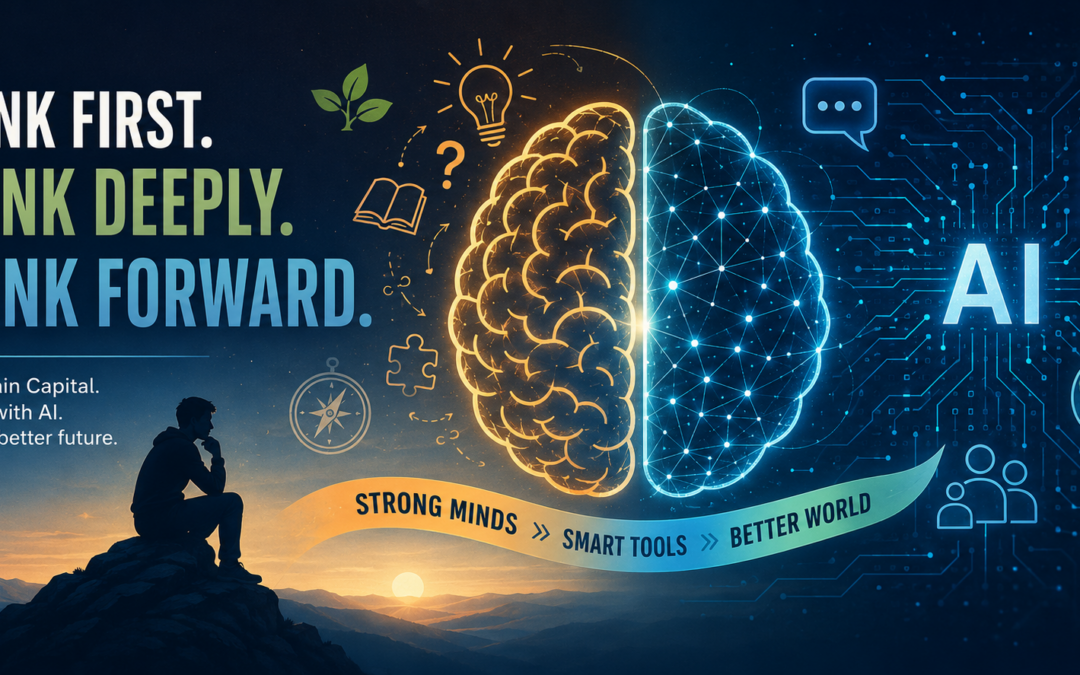
Don’t Outsource Your Mind: Building Brain Capital in the Age of Artificial Intelligence
Artificial intelligence is rapidly becoming one of the most powerful technologies humanity has ever created. Every day, it helps us write, search, analyze, summarize, design, code, translate, and solve problems that once demanded hours of focused effort.
These are remarkable capabilities.
But they also raise an important question:
What happens when we begin outsourcing not just our work—but our thinking?
Throughout history, every transformative technology has shifted human capabilities. Calculators changed how we perform arithmetic. GPS changed how we navigate. Search engines changed how we find information.
AI is different.
It has begun changing how we think.
That isn’t inherently good or bad. Like every powerful tool, its impact depends on how we use it.
AI Should Amplify Thinking—Not Replace It
Imagine walking into a gym and asking someone else to lift all the weights for you.
You would certainly save energy.
Unfortunately, you wouldn’t build any muscle.
The same principle applies to the brain.
Critical thinking, creativity, reasoning, memory, judgment, and problem solving are cognitive muscles. They become stronger through effort, challenge, reflection, and practice.
When we consistently ask AI to perform the difficult parts of thinking before we’ve engaged our own minds, we may save time—but we also miss the opportunity to strengthen the very abilities that make us uniquely human.
The goal is not to use AI less.
The goal is to think more before using AI.
Strong Minds Produce Better AI
Ironically, the people who gain the greatest benefit from artificial intelligence are often those with the strongest thinking skills.
Why?
Because AI responds to the quality of the questions we ask.
Clear thinking leads to clear prompts.
Structured reasoning produces better analyses.
Domain knowledge allows us to recognize weak answers.
Curiosity uncovers possibilities that generic prompting never will.
AI is extraordinarily capable, but it does not replace judgment. It extends it.
The better your reasoning, the better your conversations with AI become.
Brain Capital Is the Competitive Advantage
We often hear about financial capital, social capital, and intellectual property.
Increasingly, societies will compete on another form of wealth:
Brain Capital.
Brain Capital is the collective capacity of people to think clearly, solve complex problems, innovate, learn continuously, and make wise decisions.
In an AI-powered world, Brain Capital becomes even more valuable.
The future belongs not simply to those with access to AI, but to those who know how to think with AI without becoming dependent on AI.
Exercise Your Cognitive Muscles
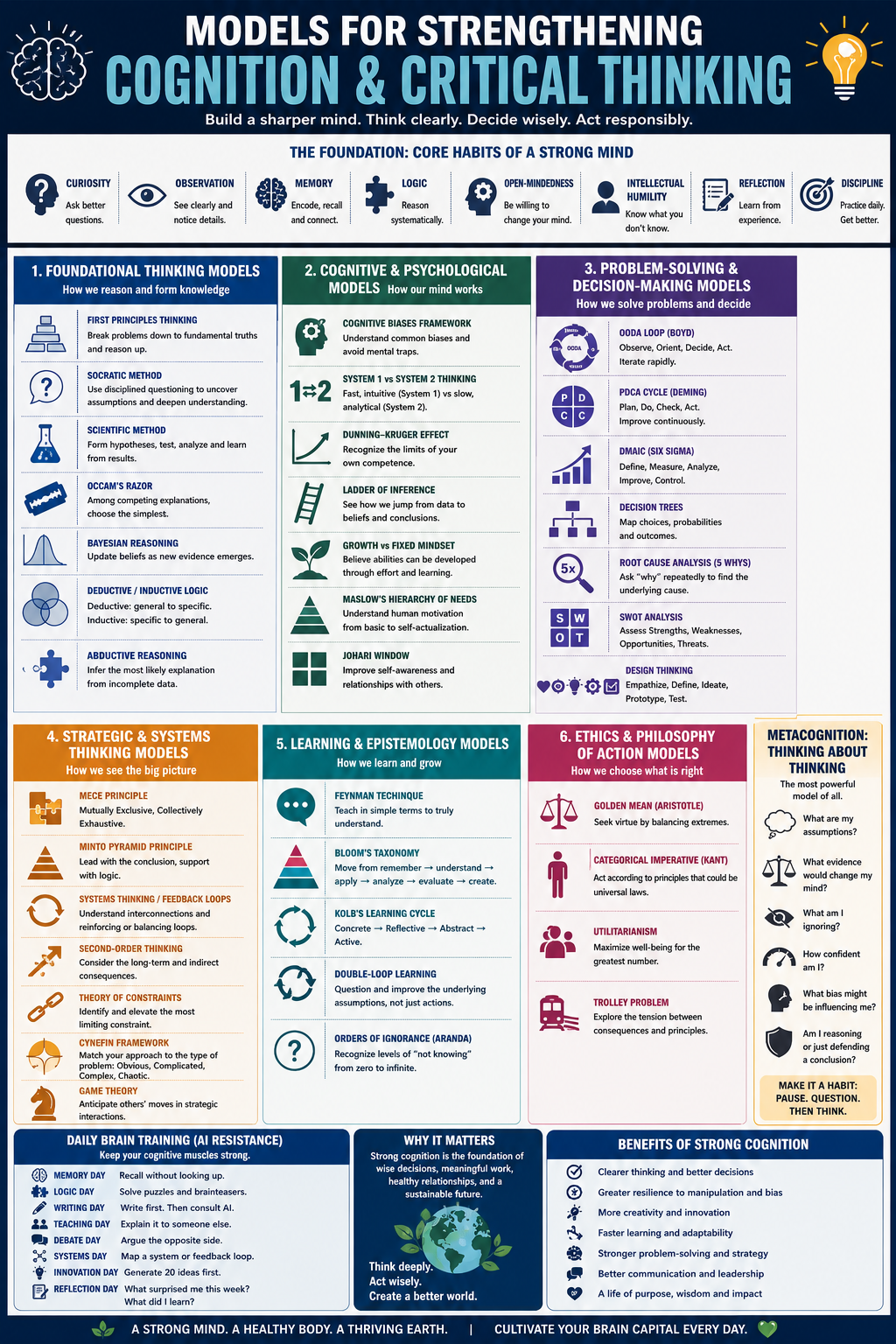
The accompanying infographic presents a collection of some of the world’s most powerful thinking frameworks.
These models have emerged from philosophy, science, psychology, systems theory, military strategy, education, business, and decision science.
Each provides another way of strengthening the mind.
Examples include:
- First Principles Thinking
- The Scientific Method
- Bayesian Reasoning
- Systems Thinking
- The Socratic Method
- The Feynman Technique
- OODA
- Design Thinking
- Second-Order Thinking
- Metacognition—the practice of thinking about your own thinking
Together they form a mental toolkit that enables people to approach problems from multiple perspectives rather than relying on intuition alone.
Build Before You Ask
One simple habit can dramatically improve both learning and AI interactions:
Think first. AI second.
Before opening ChatGPT or another AI assistant:
- Define the problem yourself.
- Write your own first draft.
- Generate several possible solutions.
- Identify your assumptions.
- Decide what you don’t yet know.
Only then invite AI into the conversation.
You’ll quickly discover that AI becomes a collaborator rather than a substitute.
Instead of replacing your thinking, it accelerates it.
A Daily Practice for the AI Age
Just as physical fitness requires regular exercise, cognitive fitness requires intentional practice.
Challenge yourself to:
- Solve problems without immediately searching for answers.
- Explain difficult concepts in your own words.
- Read deeply instead of only consuming summaries.
- Draw systems maps.
- Debate ideas respectfully.
- Learn something completely outside your field.
- Reflect on what changed your mind.
These habits build resilience against cognitive complacency while making every interaction with AI more productive.
The Future Depends on Human Thinking
Artificial intelligence will undoubtedly transform education, medicine, science, business, and nearly every profession.
But the greatest danger is not that AI becomes more intelligent.
It is that humans become less willing to do the hard work of thinking.
The future does not require choosing between human intelligence and artificial intelligence.
It requires combining them wisely.
The strongest societies will not be those that outsource cognition most efficiently.
They will be those that cultivate the greatest Brain Capital—communities of curious, disciplined, ethical, creative thinkers who use AI not to replace their minds, but to extend their reach.
Because in the end, artificial intelligence will always be most powerful when it is guided by deeply human intelligence.
I would also suggest ending the article with the infographic itself and a simple invitation:
Download the infographic. Share it with your school, university, workplace, or research team. Every conversation about AI should also be a conversation about strengthening the human mind.
Recent Comments